Imagine you walk into a store and see many organic light-emitting diode screens. You want the best screen to watch things on, but picking the right portable OLED monitor can be hard. Most people care a lot about how good the screen looks. In fact, 78% of buyers say it is the most important thing when buying devices that cost more than $800. Many people make mistakes like choosing the wrong size, not thinking about the light in the room, or forgetting about how the screen looks from different angles. If you want a display that fits your space and what you need, learning about organic light-emitting diodes and knowing.
Define Your OLED Needs
Main Use Cases
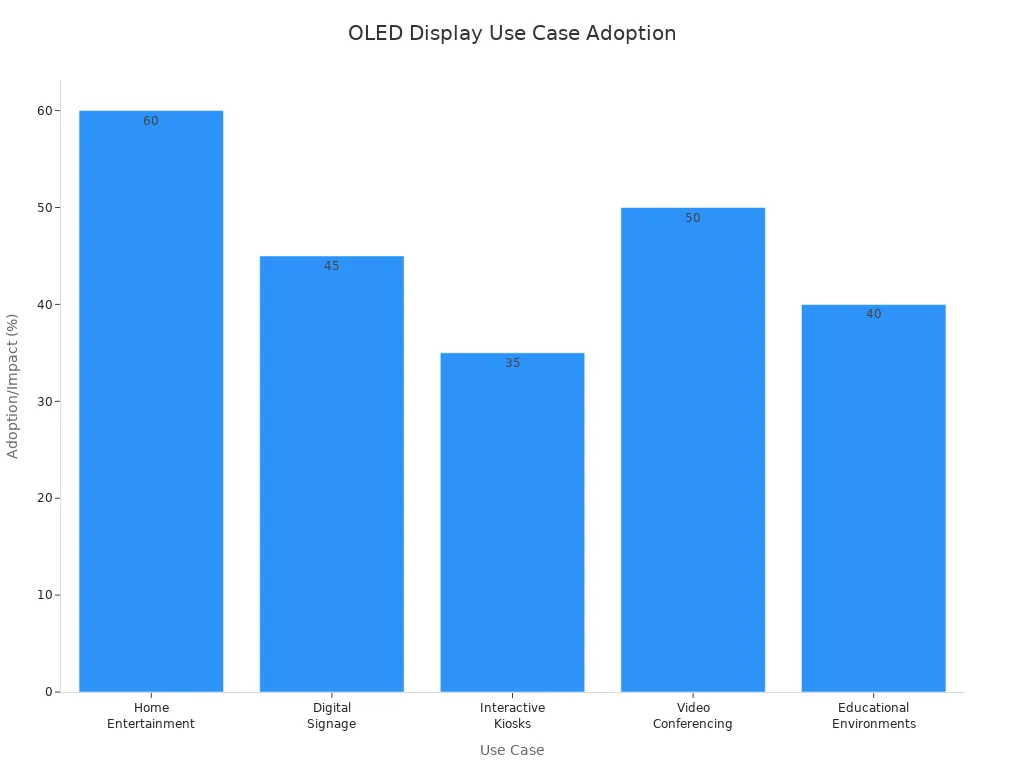
First, think about how you will use your OLED with DC dimming support. People buy these displays for different reasons. Some want to watch movies at home. Others use them for work, playing games, or teaching. The table below shows why people use OLED displays and how popular each use is:
|
Use Case |
Description |
Adoption Rate/Impact |
|---|---|---|
|
Home Entertainment & Personal Use |
OLED TVs make movies look better with great colors and contrast. |
60% of people who buy expensive TVs pick OLED. |
|
Digital Signage & Commercial Displays |
These are good for busy places because the pictures look bright. |
OLED signs went up by 45% in two years. |
|
Interactive Kiosks & Public Info Systems |
These are used for touch screens in public places. |
35% more people use these each year. |
|
Video Conferencing & Corporate Communications |
OLED makes online meetings look clear and colorful. |
50% more conference rooms use OLED now. |
|
Educational & Training Environments |
OLED helps with lessons and showing hard ideas. |
OLED use in schools may grow by 40% by 2025. |
Space and Environment
Look at your room before you buy a display. Measure the spot where you want to put your OLED display. Check how bright your room is. If your room is very bright, you need a display that is brighter. For public places, pick a display that does not show glare or fingerprints. Think about how many people will watch at the same time. Wide viewing angles help everyone see the screen well.
Feature Priorities
Pick the OLED display features that fit your needs. Most people care about how good the screen looks, but other things are important too. The table below shows what buyers want most:
|
Feature |
Description |
|---|---|
|
Display Quality |
People want bright colors, dark blacks, and strong contrast from OLED. |
|
Innovative Form Factors |
Some like foldable, curved, or thin screens for style and use. |
|
Sustainability |
Many want displays made in ways that are good for the planet. |
|
Durability |
People like screens that bend and do not break easily. |
|
Advanced Features |
Some want things like fingerprint sensors and fast screen changes. |
Decide which features are most important to you. This will help you pick the best OLED display for your life.
Key OLED Display Features
Size and Resolution
Think about the size and resolution before you buy an OLED display. Size means how big the screen is. Resolution tells you how many tiny dots, called pixels, are on the screen. More pixels make pictures look sharper and clearer. If you sit close to your screen, you need a high resolution. This stops you from seeing the little dots. This is important for things like editing photos or watching movies in 4K.
Here is a table that shows some common OLED display sizes and resolutions:
|
Size (inches) |
Resolution (pixels) |
Contrast Ratio |
Color Gamut Coverage |
|---|---|---|---|
|
21.6 |
3840 x 2160 (4K) |
1,000,000:1 |
80% BT.2020 |
|
54.3 x 30.6 cm |
1920 x 1080 (Full HD) |
N/A |
N/A |
-
More pixels make images look sharper.
-
How far you sit changes how clear the picture looks.
-
A high PPI screen looks better when you are close.
OLED displays can show true black and many colors. These things make movies, games, and work look great.
Panel Type (WRGB vs RGB)
There are two main types of OLED panels: WRGB and RGB OLED. Each type changes how bright, colorful, and long-lasting the screen is.
|
Feature |
WRGB (WOLED) |
RGB Tandem OLED |
|---|---|---|
|
Peak Brightness |
1,500 Nits |
4,000 Nits |
|
Lifespan |
20,000 hours |
50,000 hours |
|
Color Gamut |
98% (DCI-P3) |
99.8% (DCI-P3) |
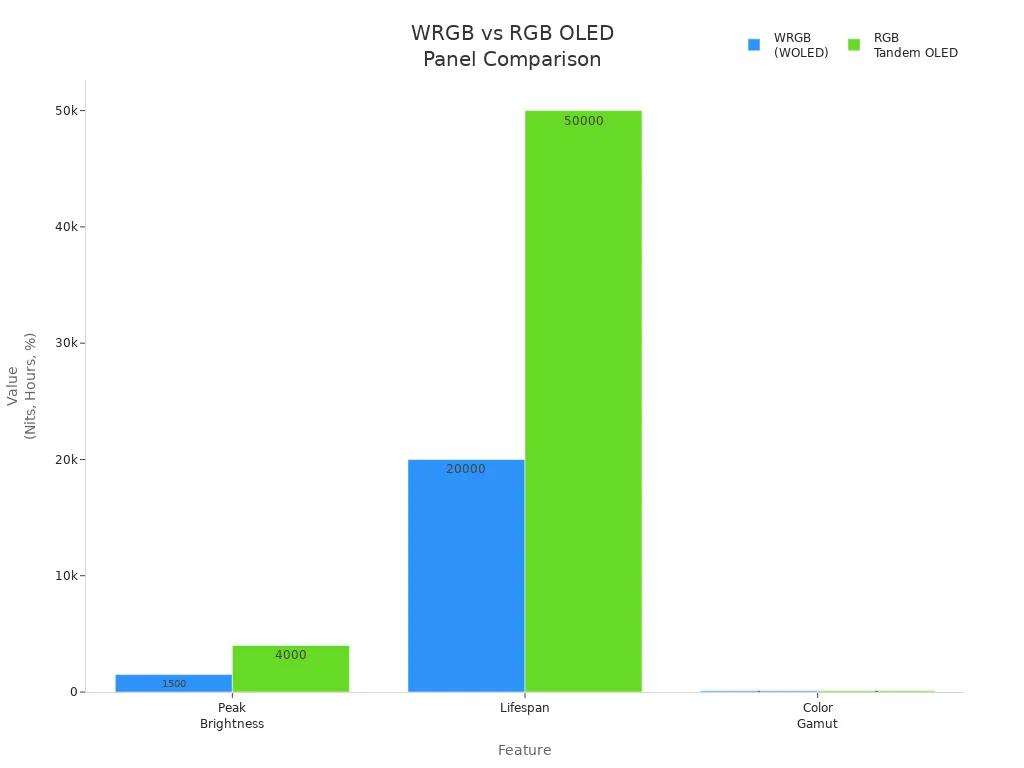
RGB OLED panels are brighter and last longer. They also show colors a little better. WRGB panels are still very good and are used in big TVs. Pick the panel type that fits what you need for brightness and color.
Brightness and Viewing Angles
Brightness is important if your room is bright. OLED displays are usually 800 to 1,000 nits bright. This is good for most homes. QLED displays can be even brighter, up to 2,000 nits. If you want to use your screen in sunlight, you may need a brighter one.
-
OLED screens keep colors and pictures looking good from the side.
-
Each pixel lights up by itself, so colors stay the same.
-
LCD screens can lose color and look worse at sharp angles, but OLEDs do not.
With OLED, everyone in the room sees the same picture, even from the side.
Color Accuracy
Color accuracy means the colors on your screen look real. OLED displays are known for showing colors very well. You can check color accuracy with a number called ΔE00. Lower numbers mean the colors are more correct.
|
ΔE00 |
Perception |
|---|---|
|
< 1.0 |
Not perceptible by human eyes |
|
1–2 |
Perceptible through close observation |
|
3–10 |
Perceptible at a glance |
If you work with photos or videos, you need a screen with a low ΔE00. This makes sure your colors look right and professional.
Touch Functionality
Touch functionality lets you use your OLED display by touching it. You can tap, swipe, or draw on the screen. This is helpful for designers, teachers, and gamers. It helps you work faster and makes games more fun. OLED screens react quickly, so your touches feel smooth.
Tip: If you want to use your screen for design or games, pick one with touch support.
Connectivity and Compatibility
You need to connect your OLED display to other things. New displays have many ways to connect:
|
Connectivity Option |
Description |
Compatible Devices |
|---|---|---|
|
I2C |
Common interface for microcontrollers |
Arduino, microcontroller platforms |
|
Qwiic Connectors |
Easy cable connection for I2C devices |
Arduino, other I2C devices |
|
SPI |
Less common, but available on some displays |
Some microcontrollers |
|
UART |
Serial port connection, rare but possible |
Arduino via serial port |
Make sure your display works with your computer, game system, or microcontroller. This helps you avoid problems later.
Durability and Build Quality
Durability means your OLED display can handle being used every day. Look for displays that meet rules like ISO 16750 for heat and shaking, or SAE J3168 for seeing the screen in different lights. Some displays also meet car safety rules.
|
Standard/Certification |
Description |
|---|---|
|
ISO 16750 |
Tests for temperature, humidity, and vibration |
|
SAE J3168 |
Checks optical performance and readability |
|
ECE Regulation No. 21 |
Ensures impact resistance and safety |
|
IATF 16949 |
Quality management for automotive displays |
A strong display with good certifications will last longer and work well in many places.
When you know about these features, you can pick an OLED display that fits what you need. You will get great pictures, true colors, and a screen you can trust.
Comparing OLED Models and Brands

Reading Specs and Reviews
When you look at OLED displays, start with the specs. Check the size, resolution, brightness, and refresh rate. These things show how the display will work in your room. You should also read reviews from trusted websites. Some good places for reviews and facts are:
-
RTINGS.com: This site has detailed reviews and compares OLED TVs and monitors. You can learn about picture quality and input lag.
-
OLED-Info.com: This site explains OLED technology and gives specs for many displays.
Reading specs and reviews helps you know what to expect before you buy.
Warranty and Support
Warranty and support are important when you buy OLED TVs or monitors. Brands give different warranty times and rules for burn-in. This can change how happy you are with your display. Check the table below to see some choices:
|
Brand |
Model |
Warranty Period |
Burn-in Policy |
|---|---|---|---|
|
ASUS |
PG32UCDM |
36 months |
Covered under warranty |
|
ASUS |
Other OLED models |
24 months |
Not specified |
-
Good support helps you fix problems fast.
-
A strong warranty and service are important for business use.
Tip: Always read the warranty rules before you buy. This keeps your money safe if something breaks.
OLED TVs vs Monitors
You should know how OLED TVs and monitors are different. The table below shows how they compare:
|
Feature |
OLED Monitors |
OLED TVs |
|---|---|---|
|
Size |
27-32 inches |
55 inches and up |
|
Resolution |
4K or 1440p |
4K is common |
|
Intended Use |
Gaming, content creation |
General viewing, movies, gaming |
|
Viewing Distance |
Close |
Farther away |
|
Refresh Rate |
Up to 240Hz |
Lower refresh rates |
OLED monitors show deep blacks and bright colors. They are good for gaming, design, and photos. OLED TVs are better for watching movies in big rooms. Both use OLED technology for great color and contrast, but they are best for different things.
Budget and Value
Balancing Price and Features
You want the best screen for your money. Many people look for high-quality screens, but they also care about price. You should think about what matters most to you. Some people want the newest technology. Others want a screen that lasts a long time. The table below shows what buyers think about when they choose an oled display:
|
Factor |
Description |
|---|---|
|
Display Quality |
People want screens that look great and show clear images. |
|
Technological Advancements |
New features and improvements attract buyers. |
|
Decreasing Costs |
Lower prices make oled displays easier to buy. |
|
Long-term Value |
Energy savings and durability help you save money over time. |
You can use this table to help you decide what is most important for your needs.
Finding the Best Value
You do not need to buy the most expensive model to get a good oled display. Look for a screen that gives you the features you want at a price you can afford. You can compare different models and brands. Check for things like warranty, support, and extra features. Sometimes, a less expensive model has everything you need.
Tip: Make a list of your top three must-have features. Use this list when you compare displays. This helps you focus on value, not just price.
Timing Your Purchase
You can save money if you buy at the right time. Stores offer big sales during certain months and events. Here are some of the best times to buy an oled display:
-
Black Friday and Cyber Monday: You can find deep discounts on many brands and sizes.
-
Holiday weekends: Stores have special deals and promotions.
-
Amazon Prime Day: Online stores offer exclusive savings.
-
Spring season: Prices drop on older models when new ones come out.
-
Late January to early February: You can find clearance sales after the holidays.
If you wait for these times, you may get a better deal on the oled display you want.
Common OLED Buying Mistakes
Ignoring Compatibility
You might get excited about a new oled, but forget to check if it works well with your devices. Many people run into problems after buying. Some common issues include:
-
Text may look blurry or unclear, especially in Windows.
-
You might see color fringing, which creates colored outlines around letters.
-
Unusual pixel layouts can cause text to look misaligned.
Always check if the oled matches your computer or system before you buy. This step saves you time and frustration later.
Overlooking Durability
You want your oled to last, but not all displays have the same lifespan. QLED and LCD displays often last much longer than oled screens. Burn-in is a real concern for oled users. This happens when images stay on the screen too long and leave marks. QLED technology stands out for its longer life and better durability. Take a look at the table below to see how long each type can last:
|
Display Type |
Lifespan (Hours) |
|---|---|
|
OLED |
5,000 |
|
LCD |
60,000 |
|
QLED |
Not specified |
If you plan to use your display every day, think about how long it will last.
Focusing Only on Specs
You may want the highest numbers, but specs do not tell the whole story. When you focus only on technical details, you can miss important drawbacks:
-
Oled screens have a shorter lifetime, especially blue oled, which lasts about 1.6 years.
-
They cost more than LCD displays.
-
Water can damage them easily.
-
They do not work as well in bright sunlight.
-
The screen can get dimmer over time.
-
Fewer models are available in stores.
Tip: Look beyond the numbers. Think about how you will use your oled and where you will put it.
Skipping After-Sales Support
After-sales support matters more than you might think. Good support helps you fix problems fast and keeps you happy with your purchase. The table below shows why support is important:
|
Evidence Type |
Description |
|---|---|
|
Customer Spending |
Customers with great support spend 67% more with a brand. |
|
Customer Loyalty |
Fast, helpful support builds trust and keeps you coming back. |
|
Brand Advocacy |
Happy customers tell others, which helps the brand grow. |
If you skip checking support options, you might regret it later. Always look for brands with strong customer service.
Picking the right OLED monitor for MacBook Pro means you need to think about what is important for your room and what you want. Use this table to help you remember the main things to check:
|
Key Considerations |
Description |
|---|---|
|
Ambient Light Levels |
OLED works best in rooms with controlled lighting. |
|
Content Composition |
Moving images look best; static images can cause wear. |
|
Viewing Distance |
Sit close or mid-range for sharp details. |
|
Panel Handling and Mounting |
Handle and mount your display with care for long life. |
You should also look at these things before you buy:
-
How good the picture and colors look
-
The design and how it fits your style
-
How much energy it uses
-
If it might get burn-in or how long it lasts
-
The price and if it is worth it
-
How OLED is different from other screens
When you pick a display that fits what you really need, you will not be disappointed. You will enjoy using your screen every day. The best OLED is the one that makes you happy and gives you a great time.