Choosing between the NVIDIA Spectrum-4 SN5600 and the Cisco Nexus G200 shapes your entire AI network strategy. You need a switch that handles massive GPU traffic without bottlenecks. The NVIDIA platform integrates deeply with Spectrum-X and BlueField-3, creating a tightly coupled fabric for accelerated computing. Cisco counters with multi-vendor flexibility and UEC compliance, appealing to heterogeneous environments.
Your data center's future depends on this decision. The NVIDIA fabric excels in lossless Ethernet and adaptive routing, minimizing tail latency for distributed training. Cisco's strength lies in standards-based interoperability, allowing you to mix equipment from multiple vendors. You must weigh ecosystem lock-in against operational freedom.
Consider your AI workloads' scale and your tolerance for vendor-specific optimizations. This comparison helps you evaluate both platforms against your specific requirements.
Key Takeaways
-
Choose NVIDIA SN5600 for tight AI ecosystem integration with DGX and BlueField-3, delivering superior performance and automation.
-
Choose Cisco Nexus G200 for multi-vendor flexibility and UEC compliance, ideal for heterogeneous and regulated environments.
-
Both switches deliver 51.2 Tbps throughput, but NVIDIA excels in lossless Ethernet and adaptive routing, while Cisco offers granular traffic engineering.
-
Evaluate your workload scale, ecosystem commitment, and compliance needs to align your choice with long-term infrastructure goals.
-
Run a proof-of-concept with your actual workloads to validate performance and operational fit before committing.
Platform Overview: SN5600 vs. Cisco Nexus G200
Before you evaluate performance metrics, you need to understand what drives each platform. The NVIDIA Spectrum-4 SN5600 and the Cisco Nexus G200 represent two distinct philosophies for 800GbE networking. Your choice between them shapes your entire AI fabric strategy.
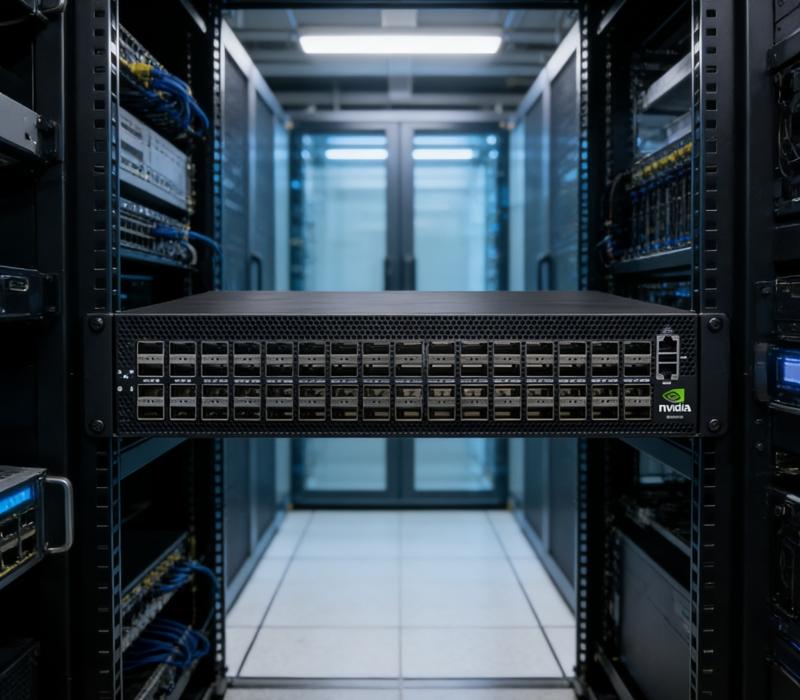
Inside the NVIDIA Spectrum-4 SN5600: ASIC and Buffer
The NVIDIA Spectrum-4 SN5600 centers on a purpose-built ASIC that delivers exceptional throughput for AI workloads. This switch provides a bi-directional bandwidth capacity of 51.2 Tbps, guaranteeing high throughput with low latency. You get this performance through a clever SerDes design:
-
The Spectrum-4 ASIC uses 100 Gb/s SerDes lanes, achieved through 50 Gb/s native signaling with PAM-4 encoding (2 bits per signal).
-
These lanes gang in groups of 8 to form a single 800 GbE port.
-
With 64 such ports, the aggregate throughput is calculated as: 64 ports × 800 Gb/s = 51.2 Tb/s.
-
This configuration specifically targets regional datacenter interconnects, where 800 GbE ports are the key enabler.
Beyond raw speed, the SN5600 features a fully shared dynamic packet buffer architecture. This design absorbs microbursts effectively, maintaining predictable low latency during distributed training. You also gain native RoCE support and optimization for NVIDIA Spectrum-X Ethernet, creating a tightly integrated fabric for GPU clusters. The switch processes up to 33.3 billion packets per second, ensuring no packet loss under sustained load.
Cisco Nexus G200: Silicon One and UEC Readiness
The Cisco Nexus G200 takes a different approach with its Silicon One G200 ASIC. This switch emphasizes multi-vendor interoperability and standards compliance. You benefit from flexible port configurations that adapt to diverse network environments.
|
Specification |
Value |
|---|---|
|
Throughput |
51.2 Tbps (full-duplex) |
|
Port Configuration |
64x800GE to 512x100GE |
Cisco positions this platform for UEC readiness, meaning you can integrate it into heterogeneous fabrics without proprietary lock-in. The Silicon One architecture supports advanced traffic engineering, giving you granular control over data flows. For compliance-heavy environments, the Cisco Nexus line offers familiar NX-OS management, reducing operational overhead.
Your decision hinges on ecosystem priorities. The NVIDIA platform excels when you commit to NVIDIA Spectrum-X Ethernet and BlueField-3 integration. Cisco appeals when you need flexibility across multiple vendors. Both switches deliver 51.2 Tbps, but their strengths diverge in how they handle AI fabric optimization versus standards-based adaptability.
Side-by-Side Spec Comparison
You need concrete numbers to evaluate these platforms. Both switches deliver 51.2 Tbps of full-duplex throughput, but their architectural choices diverge significantly. The table below captures the essential specifications you must consider.
|
Specification |
NVIDIA Spectrum-4 SN5600 |
Cisco Nexus G200 |
|---|---|---|
|
ASIC |
Spectrum-4 |
Silicon One G200 |
|
Throughput |
51.2 Tbps |
51.2 Tbps |
|
Port Density |
64x800GbE to 512x100GbE |
64x800GE to 512x100GE |
|
Packet Processing |
33.3 Bpps |
Comparable line-rate |
|
Buffer Architecture |
Fully shared dynamic packet buffer |
Configurable shared buffer |
|
Management OS |
Cumulus Linux / NVIDIA OS |
NX-OS |
Performance Stats: Line-Rate, Ports, and Latency
The NVIDIA Spectrum-4 SN5600 achieves true 800G line rate across all 64 ports simultaneously. You get this performance through 100 Gb/s SerDes lanes using PAM-4 encoding. Each port groups eight lanes to form a single 800GbE connection. This configuration targets regional data center interconnects where high-density 800GbE ports eliminate bottlenecks.
Cisco's Silicon One G200 matches this throughput with identical port density. You can configure the switch flexibly from 64 ports at 800GE down to 512 ports at 100GE. This flexibility suits diverse network topologies. Both platforms process packets at line rate without dropping frames under sustained load.
Latency differentiates these switches in subtle ways. The NVIDIA platform maintains predictable low latency through its dynamic buffer design. You experience consistent packet forwarding even during microburst events. Cisco achieves comparable latency figures through its Silicon One architecture, though the buffer management strategy differs. Your workload determines which approach serves you better.
Congestion Control and Adaptive Routing
AI workloads create unique traffic patterns that overwhelm traditional congestion control mechanisms. You need intelligent fabric management to maintain throughput during distributed training. Both vendors address this challenge differently.
NVIDIA implements adaptive routing directly within the Spectrum-4 ASIC. This feature dynamically reroutes traffic around congested paths without CPU intervention. You benefit from automatic path selection that responds to real-time fabric conditions. The switch pairs this capability with native RoCEv2 support, enabling lossless Ethernet for RDMA traffic. NVIDIA's approach minimizes tail latency by preventing hotspots before they form.
Cisco relies on standard-based congestion control mechanisms, primarily DCQCN (Data Center Quantized Congestion Notification). You configure explicit congestion notification thresholds to manage buffer occupancy. The Silicon One ASIC supports advanced traffic engineering, giving you granular control over flow placement. This standards-based approach ensures interoperability with third-party switches in your fabric.
The management experience differs substantially between platforms. NVIDIA offers Cumulus Linux, providing you with a familiar Linux-based operating environment. You automate the switch using standard DevOps tooling. Cisco's NX-OS delivers the command-line interface that network engineers already know. Your team's operational familiarity should influence your selection.
For AI fabric optimization, NVIDIA's adaptive routing provides a distinct advantage. The switch automatically balances traffic across available paths, reducing congestion-related packet drops. Cisco's approach requires more manual tuning but offers greater control for specialized environments. You must evaluate whether automation or granular control aligns with your operational model.
The buffer architecture represents another critical distinction. NVIDIA's fully shared dynamic buffer absorbs microbursts effectively, maintaining consistent performance during bursty AI traffic. Cisco's configurable buffer lets you allocate resources based on your specific traffic profile. Both approaches prevent packet loss, but they achieve this outcome through different mechanisms.
Your choice ultimately depends on your fabric's complexity and your team's expertise. The NVIDIA platform excels in tightly integrated AI environments where automation matters. Cisco's flexibility serves heterogeneous networks that require manual optimization.
Performance and AI Fabric Features
Lossless Ethernet and RDMA Optimizations
Your AI cluster demands lossless ethernet to protect RDMA traffic from packet drops. The NVIDIA SN5600 delivers native RoCEv2 support with a fully shared dynamic packet buffer. This architecture absorbs microbursts at the switch level, preventing congestion from spreading across your fabric. You maintain predictable latency even when multiple GPU nodes burst simultaneously during training checkpoints.
Cisco achieves lossless transport through Data Center Bridging protocols. Priority Flow Control (PFC) sends pause frames to manage Ethernet flows, while Explicit Congestion Notification (ECN) marks packets experiencing congestion without dropping them. This standards-based approach interoperates with third-party switches in your network. You configure these mechanisms through NX-OS, tuning thresholds to match your workload profile.
The NVIDIA platform minimizes tail latency through its dynamic buffer allocation. When one port experiences a burst, the switch redistributes buffer capacity from idle ports automatically. Your distributed training jobs avoid the straggler effect that slows overall iteration time. Cisco's configurable buffer requires manual tuning but offers granular control for specialized traffic patterns.
Traffic Engineering for AI Workloads
NVIDIA Spectrum-X Ethernet integrates adaptive routing directly into the ASIC. The switch reroutes traffic around congested paths without CPU intervention, responding to real-time fabric conditions. You benefit from automatic path selection that prevents hotspots before they form. This capability proves essential for your ai back-end fabric, where traffic patterns shift unpredictably across thousands of GPU connections.
Cisco counters with Intelligent Packet Flow, a comprehensive traffic engineering suite. The Silicon One G200 supports dynamic load balancing (flowlet-based) that distributes traffic based on link utilization telemetry. You also gain per-packet load balancing, which sprays packets across multiple paths for maximum throughput. Weighted Cost Multipath (WCMP) enables intelligent path weighting for asymmetric topologies. Policy-based load balancing assigns specific strategies to mixed workloads based on ACLs, DHCP markings, or RoCEv2 headers.
Visibility differentiates these platforms for ai workload analytics. Cisco provides hardware flow telemetry that accounts for every packet traversing the switch, including micro-bursts and drops. ECN mark counters report congestion per device, per interface, and at flow level through Nexus Dashboard Insights. PFC packet statistics reveal pause frames issued per class of service, enabling real-time congestion tuning. NVIDIA counters with Spectrum-4's integrated telemetry, giving you fabric-wide visibility through the Spectrum-X management plane.
Your ai back-end fabric benefits from both approaches. NVIDIA's adaptive routing reduces manual intervention, ideal for large-scale AI training where automation matters. Cisco's policy-based controls suit heterogeneous environments requiring precise traffic handling. The switch you choose determines how much control you exercise over your ai cluster's data flows.
Use Case Scenarios: When to Choose Each
Your workload characteristics determine which platform serves you best. The NVIDIA SN5600 excels in tightly integrated AI environments, while the Cisco Nexus G200 thrives in heterogeneous, compliance-driven networks. Understanding these scenarios helps you align your infrastructure investment with your operational reality.
NVIDIA SN5600 for Tight NVIDIA Ecosystem (DGX, BlueField)
You operate an NVIDIA-centric AI infrastructure when your compute nodes, storage, and networking form a unified stack. The nvidia spectrum-4 sn5600 integrates seamlessly with DGX SuperPOD architectures, delivering the bandwidth your GPU clusters demand. NVIDIA designs this switch specifically for Spectrum-X Ethernet fabrics, creating a cohesive environment where every component communicates optimally.
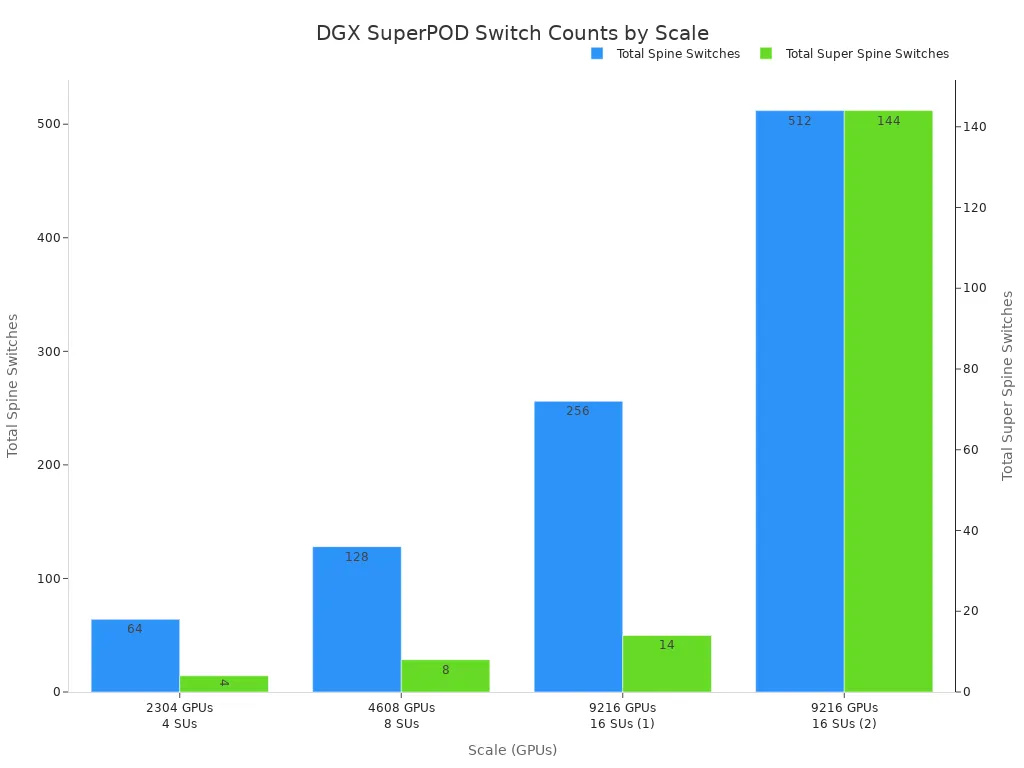
The DGX SuperPOD reference architecture demonstrates this integration clearly. You scale your AI training environment from 2,304 GPUs up to 9,216 GPUs across 16 Scalable Units. Each SU pairs two SN5600 switches as the spine layer, aggregating leaf switches that face DGX compute trays and storage. For larger deployments, you add a super spine layer with 2 groups, maintaining non-blocking characteristics throughout your fabric.
|
Scale (GPUs) |
Scale (SUs) |
Super Spine Groups |
Super Spines per Group |
Total Super Spine Switches |
Total Spine Switches |
|---|---|---|---|---|---|
|
2304 |
4 |
2 |
2 |
4 |
64 |
|
4608 |
8 |
2 |
4 |
8 |
128 |
|
9216 |
16 |
2 |
7 |
14 |
256 |
|
9216 |
16 |
6 |
24 |
144 |
512 |
BlueField-3 DPU integration elevates your ai cluster performance further. The DOCA 2.7 release enables the Spectrum-X 1.0.1 reference architecture, tested specifically for BlueField SuperNICs paired with SN5600 switches. This architecture delivers lossless ethernet through adaptive routing and DOCA programmable congestion control. You achieve GPUDirect RDMA with BlueField SuperNICs shipped in NIC mode by default, simplifying deployment.
Benchmark results demonstrate the tangible impact. A fine-tuning workload completes in 1 hour 40 minutes with GPUDirect RDMA using SN5600 and BlueField-3. The same workload takes 2 hours 30 minutes with TCP/Socket over Spectrum-4 Ethernet, and 5 hours with a default OVN network. You gain a 3x improvement over the baseline configuration, directly accelerating your AI training cycles.
Cisco Nexus G200 for Multi-Vendor and FedRAMP Environments
You choose the Cisco Nexus G200 when your data center spans multiple vendors and compliance requirements dominate your decision-making. This switch supports UEC standards readiness, allowing you to integrate equipment from various manufacturers without proprietary constraints. Your network remains open and adaptable as standards evolve.
The cisco nexus platform excels in environments where you cannot commit to a single ecosystem. You mix switches from different vendors, maintaining operational flexibility across your infrastructure. NX-OS management provides familiar tooling for your network engineering team, reducing training overhead and operational risk.
FedRAMP compliance represents a critical differentiator for government and regulated industries. Cisco's established compliance framework simplifies your certification process. You deploy the G200 into environments requiring strict security controls, knowing the platform meets rigorous federal standards. This capability proves essential for public sector contracts and regulated commercial workloads.
Your ai back-end fabric benefits from Cisco's policy-based traffic engineering. You configure load-balancing strategies that match your specific workload patterns, whether you run distributed training or inference at scale. The Silicon One G200 ASIC provides granular control over data flows, enabling precise management of your ai cluster resources.
The decision ultimately rests on your ecosystem strategy. Choose NVIDIA when you commit to a tightly integrated AI stack with DGX and BlueField components. Select Cisco when you need multi-vendor flexibility, UEC compliance, and established regulatory credentials. Your ai back-end fabric architecture should reflect your organization's long-term infrastructure vision.
Decision Framework and Checklist
Key Selection Criteria: Scale, Ecosystem, and Standards
Your evaluation begins with workload scale. The NVIDIA SN5600 excels when you operate large-scale AI training environments with thousands of GPUs. The Cisco Nexus G200 serves heterogeneous fabrics where multi-vendor interoperability matters more than tight integration. You must assess your ai cluster growth trajectory honestly before committing to either platform.
Ecosystem commitment shapes your decision significantly. The nvidia platform delivers maximum value when you pair it with DGX systems and BlueField-3 DPUs. This integration creates a cohesive ai fabric with automated optimization. The cisco nexus alternative provides operational freedom, allowing you to mix switches from different manufacturers without proprietary constraints. Your tolerance for vendor lock-in determines which approach aligns with your infrastructure strategy.
Standards readiness influences long-term viability. Cisco positions the G200 for UEC compliance, future-proofing your network as industry standards evolve. NVIDIA focuses on Spectrum-X optimization, delivering superior performance today through proprietary enhancements. You must weigh immediate ai workload analytics benefits against future interoperability requirements.
Practical Checklist for Data Center Architects
Work through this checklist before selecting your 800GbE switch platform:
-
Document your primary workload types: distributed training, inference, or mixed enterprise traffic.
-
Calculate your required bandwidth per rack and aggregate fabric capacity.
-
Evaluate your team's operational familiarity with Cumulus Linux versus NX-OS.
-
Assess your tolerance for vendor-specific optimizations versus open standards.
-
Verify compliance requirements, including FedRAMP for government contracts.
-
Project your ai cluster growth over the next three to five years.
-
Test both platforms in a proof-of-concept with your actual workload patterns.
Your ai-ready infrastructure depends on matching switch capabilities to operational reality. The nvidia platform delivers superior performance for dedicated AI environments. The cisco switch provides flexibility for diverse data center ecosystems. Run controlled benchmarks measuring throughput, latency, and congestion behavior under your specific traffic profiles.
The decision ultimately balances immediate performance needs against long-term architectural flexibility. Your data center architecture should reflect your organization's strategic direction. Choose the platform that serves your ai cluster requirements today while accommodating future growth.
Your ai fabric decision hinges on your ecosystem strategy. The nvidia platform excels in tightly integrated ai fabrics with superior native RDMA and buffer management. Your ai workloads benefit from the nvidia Spectrum-4 ASIC's dynamic buffer allocation. The nvidia switch minimizes tail latency for distributed training. The cisco nexus alternative provides greater flexibility in multi-vendor settings. Your network remains open with UEC compliance built into the cisco switch. You must evaluate your data center requirements against each platform's strengths. The right ai-ready infrastructure depends on your scale, ecosystem, and compliance needs. Evaluate your ai workload characteristics and run a proof-of-concept to validate your choice. Your nvidia fabric delivers peak performance for dedicated ai clusters. Your cisco network supports heterogeneous environments with diverse data flows. For nvidia-centric environments, this fabric choice ensures optimal performance for your ai fabric.
FAQ
Which platform delivers better performance for AI training workloads?
The NVIDIA SN5600 excels in dedicated AI environments through Spectrum-X optimization and adaptive routing. Its dynamic buffer absorbs microbursts effectively, minimizing tail latency during distributed training. Cisco offers comparable throughput but requires more manual tuning for AI-specific traffic patterns. Your workload scale determines which approach serves you better.
Can I integrate either switch into an existing multi-vendor network?
Cisco Nexus G200 provides superior flexibility for heterogeneous environments. Its UEC compliance and standards-based congestion control interoperate seamlessly with third-party equipment. The NVIDIA switch integrates best within a complete NVIDIA ecosystem. Your tolerance for vendor lock-in should guide this decision.
What management experience should I expect from each switch?
NVIDIA offers Cumulus Linux, providing a familiar Linux-based operating environment. You automate the switch using standard DevOps tooling. Cisco delivers NX-OS with the command-line interface network engineers already know. Your team's operational familiarity with either platform reduces training overhead and operational risk.
How do these switches handle congestion control differently?
NVIDIA implements adaptive routing directly within the Spectrum-4 ASIC, dynamically rerouting traffic around congested paths without CPU intervention. Cisco relies on DCQCN and explicit congestion notification thresholds. You configure these mechanisms through NX-OS, tuning parameters to match your specific workload profile and fabric topology.
Which switch better supports future standards evolution?
Cisco positions the Nexus G200 for UEC readiness, future-proofing your network as industry standards mature. NVIDIA focuses on Spectrum-X optimization, delivering superior performance today through proprietary enhancements. Your long-term infrastructure vision determines which approach aligns with your data center architecture strategy.