Ceiling structure
In any magnetic track lighting project, the ceiling structure is the first and most important factor that determines how the entire system will be installed, supported, and maintained in the long term. 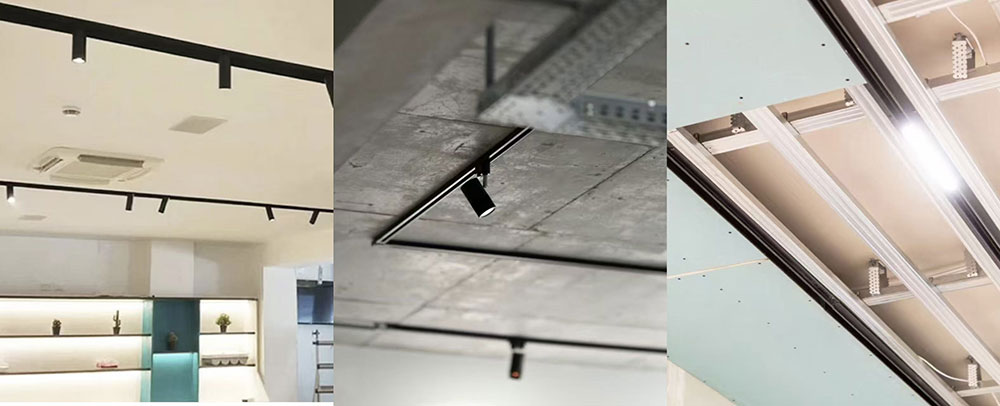
Concrete ceilings provide the most stable base because the track can be directly fixed using anchors or screws, which ensures strong load-bearing capacity even for long continuous lighting runs that include multiple linear modules and spot fixtures. However, in drywall ceiling environments, the situation is more complex. The surface itself cannot carry the full load, so installers usually need to add internal reinforcement structures or pre-installed mounting profiles before the track is fixed. Without this preparation, long-term stability may be compromised, especially in commercial projects where lighting systems are expected to run for many hours per day.
Suspended ceiling systems introduce another layer of coordination. In these cases, the lighting track is not simply attached to the ceiling surface but must be integrated with the metal grid structure behind it. This requires early coordination between lighting design and ceiling construction teams, because once the ceiling is closed, any adjustment becomes highly difficult and costly. In real architectural projects, this is why lighting layout is often finalized together with ceiling design rather than treated as a separate step.
Driver position
Magnetic track lighting systems operate on low-voltage power, typically 24V or 48V, which means the driver is not just an accessory but a core component of the entire lighting system architecture.
The position of the driver has a direct influence on both electrical performance and long-term reliability. When the driver is installed too far from the track, voltage drop can occur along the cable, especially in long-run systems where multiple fixtures are connected across extended distances. This often results in uneven brightness, where fixtures closer to the power source appear slightly brighter than those at the far end of the track.
Another critical issue is maintenance accessibility. In many real-world installations, drivers are fully hidden inside ceilings for aesthetic reasons, but this creates a long-term problem when maintenance or replacement is required. For this reason, professional lighting projects usually reserve a dedicated access point, such as a ceiling hatch or serviceable panel, allowing technicians to inspect or replace the driver without damaging the ceiling finish.
In commercial environments such as retail stores, showrooms, or hospitality spaces, this consideration becomes even more important because lighting systems are expected to remain stable for long operational hours and must be serviceable without interrupting the interior structure.
Track layout
Although magnetic track lighting systems are modular by nature, the layout design still needs to follow a clear lighting logic that is based on spatial function rather than ceiling geometry.
In retail environments, the layout is usually driven by product positioning. Lighting tracks are aligned to highlight key display areas, guide customer attention, and create visual hierarchy across different product zones. In showrooms, the layout becomes more narrative-driven, often guiding visitors through a sequence of lighting-focused product experiences. In residential or office applications, the design shifts toward functional zoning, where lighting supports daily activities such as working, relaxing, or circulation. 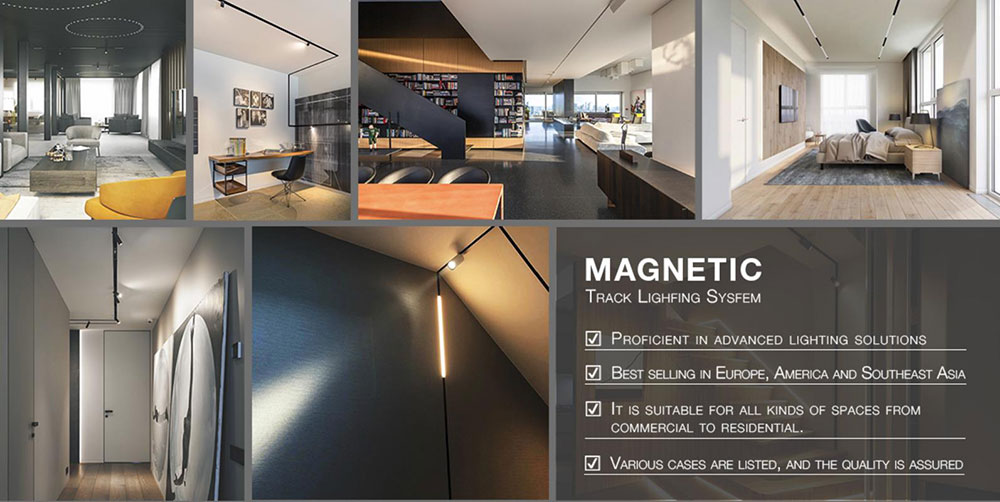
A well-designed layout ensures that lighting is distributed evenly and purposefully across the space. Without proper planning, even high-quality magnetic fixtures may produce uneven illumination, creating overly bright areas in some zones and insufficient lighting in others. This is why layout planning is not only an aesthetic decision but also a functional requirement that directly affects lighting performance.
Connectors
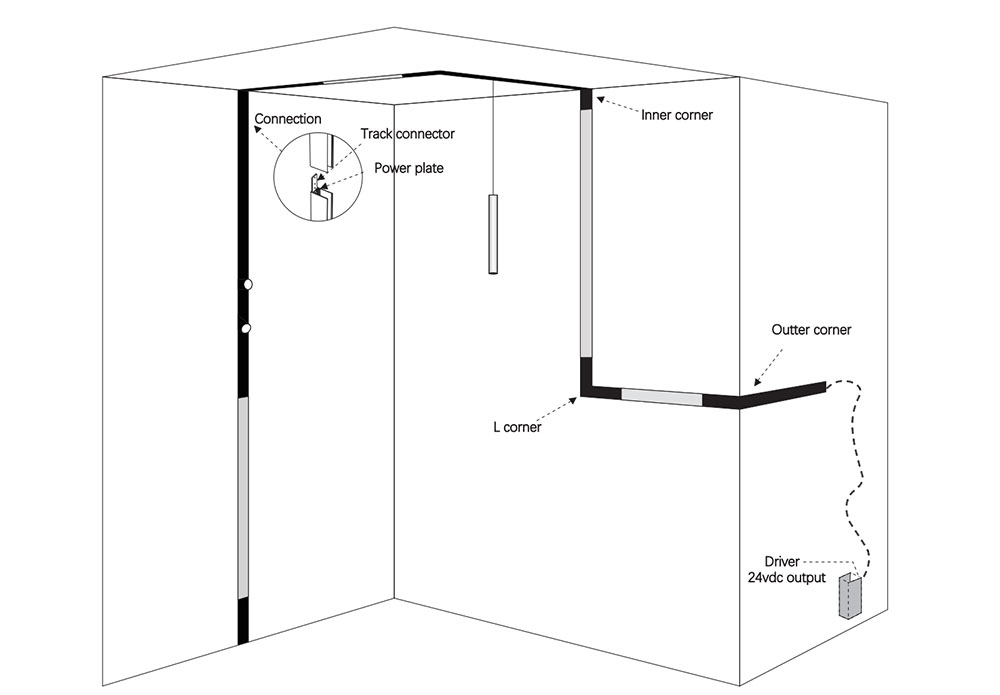
Magnetic track lighting systems are composed of multiple track segments that must be seamlessly connected both electrically and mechanically, and this is achieved through a series of specialized connectors.
Straight connectors are used when extending the track in a linear direction, ensuring continuity across longer spans. L-shaped connectors allow direction changes, making it possible to follow corners or architectural transitions. T connectors enable branching layouts, which are often used in more complex retail or exhibition spaces where lighting needs to cover multiple zones from a single power source.
Although these connectors appear simple, their installation precision is extremely important. Even minor misalignment between two track sections can lead to visible gaps in the ceiling line, which affects the visual quality of the installation. More importantly, poor contact between connectors may result in intermittent power delivery, which can cause flickering or unstable operation of fixtures along the track.
For this reason, experienced installers often treat connector alignment as one of the most sensitive steps in the entire installation process.
Fixture compatibility
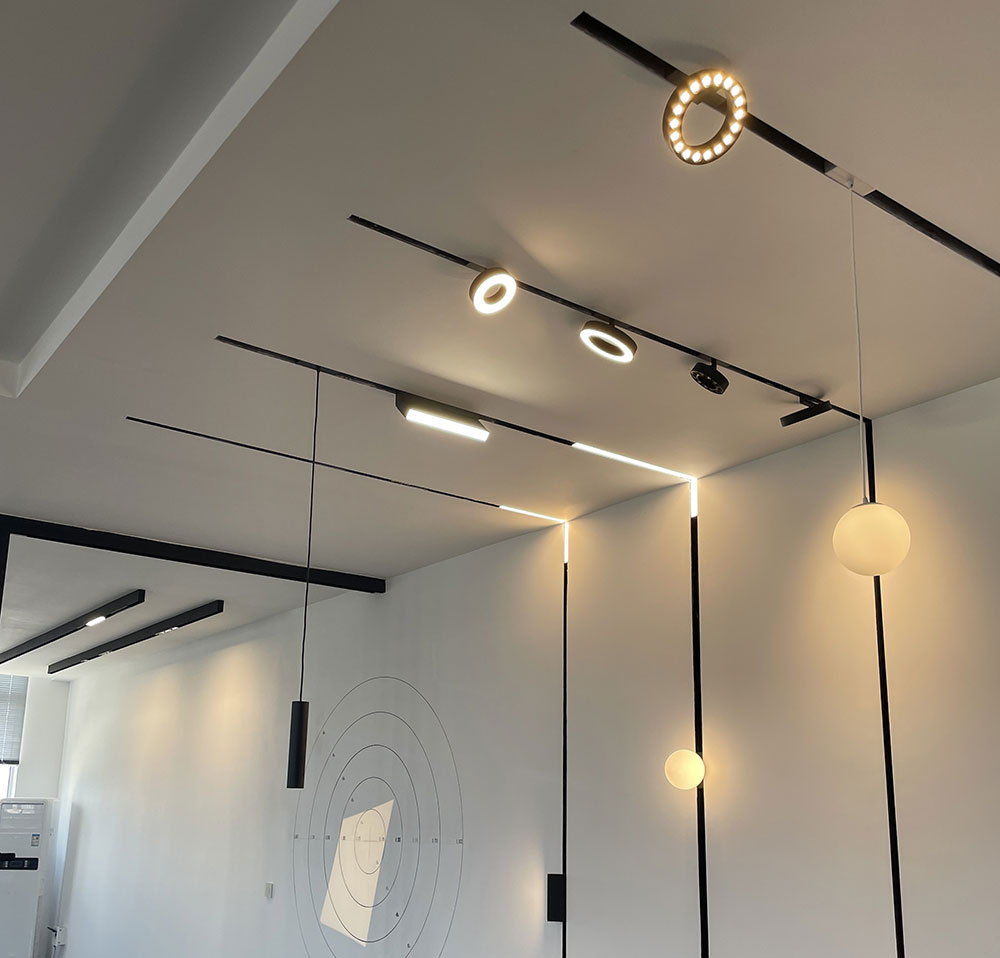
As magnetic track lighting systems evolve into more advanced architectural solutions, it is common to combine multiple fixture types within a single continuous track system, including linear modules for ambient illumination, spotlights for directional accent lighting, wall wash modules for vertical surface enhancement, and pendant fixtures for decorative or focal purposes.
When different fixture types are integrated into the same system, compatibility becomes a system-level concern rather than an individual product feature. Even if each module performs correctly on its own, variations in electrical characteristics, dimming curves, or color consistency can lead to uneven lighting behavior when they are used together in one continuous track.
This is particularly important in architectural projects where lighting is expected to deliver both functional performance and visual consistency across different zones of the same space. Proper system matching ensures that all modules respond uniformly under dimming control and maintain consistent output throughout the installation.
Installation quality
Once a magnetic track lighting system is fully installed and powered on, most structural and electrical decisions can no longer be adjusted without reopening parts of the ceiling, which is why installation quality plays a decisive role in the final outcome of the project.
Proper installation is not only about fixing the track in place but also about ensuring precise alignment, stable electrical connections, correct driver configuration, and fully tested system performance before the ceiling is closed. Any small deviation at this stage can later result in visible issues such as uneven light distribution, flickering, or difficulty in maintenance.
In well-executed projects, the magnetic track lighting system becomes almost invisible as a technical structure. It integrates seamlessly into the architectural environment and delivers consistent lighting performance without drawing attention to the system itself. This level of result can only be achieved when installation is treated as part of the design process rather than a separate construction step.