Selecting the best ddr5 ram requires evaluating module architecture, transfer speed, capacity per socket, voltage efficiency, and enterprise workload demands. Modern high-performance servers depend on advanced memory subsystems to support platforms like Intel Xeon Scalable and AMD EPYC. Deploying a ddr5 server memory module delivers exceptional bandwidth and ultra-low latency for mission-critical data center operations.
When you execute a server ram upgrade, you immediately improve system reliability and bus data path integrity. Next-generation ddr5 technology incorporates on-die error correction to prevent unexpected hardware downtime. You protect your enterprise infrastructure through planned server upgrades. Proper memory density ensures optimal enterprise performance under continuous heavy computing loads.
Key Takeaways
-
Upgrading to DDR5 server memory boosts system bandwidth and reduces energy use with efficient 1.1V operation.
-
Choosing modern module architectures like RDIMMs or MRDIMMs optimizes data speed for heavy enterprise workloads.
-
Advanced error correction features protect data integrity and prevent costly system downtime in data centers.
-
Populating memory channels symmetrically ensures peak processing speed and maintains overall server stability.
Understanding DDR5 Module Types and Architectures
Selecting the correct server memory module architecture ensures operational stability in enterprise servers. You need to understand physical server memory design differences to maximize modern hardware investments. Different enterprise workloads require tailored memory choices across your infrastructure to achieve peak efficiency.
RDIMM vs LRDIMM vs MRDIMM Mechanics
|
Memory Type |
Key Structural Components |
Operational Mechanics & Capabilities |
Target Applications |
|---|---|---|---|
|
RDIMM |
Integrated Register Buffer |
Buffers command, address, and clock signals to lower electrical load on the memory controller, adding roughly one clock cycle of latency. |
Standard server hardware and high-reliability systems |
|
LRDIMM |
Registering Clock Driver + Data Buffers |
Buffers control signals and re-drives data lines via data buffers, hiding raw DRAM chips from the controller to maximize heavy loading limits. |
Standard server hardware and high-density deployments |
|
MRDIMM |
On-DIMM Multiplexing Buffer & Control Logic |
Simultaneously operates two ranks through a multiplexer, effectively doubling channel throughput beyond native ddr5 rates (e.g., ~70.4 GB/s at 8800 MT/s). |
AI, High-Performance Computing (HPC), and next-gen server platforms |
Multiplexed Rank Dual Inline Memory Modules utilize an on-DIMM multiplexing buffer paired with dedicated control logic to combine dual-rank ddr5 operations. By concurrently managing data streams across multiple memory ranks, these advanced modules transcend standard ddr5 speed limits. You gain higher data throughput, reduced latency, larger effective capacity, and enhanced power efficiency per watt. These modules deliver a 128-byte data payload to the processor during each cycle, doubling the 64-byte payload capability of standard ddr5 modules during continuous compute operations.
MRDIMMs integrate high-speed multiplexing technology to allow simultaneous rank access rather than processing operations sequentially like standard memory interleaving, thereby doubling the effective per-pin data rate and maximizing bandwidth.
-
Concurrent Rank Access: MRDIMM architecture enables concurrent activation and fetching across pairs of DRAM ranks, substantially elevating throughput compared to standard single-rank ddr5 operations.
-
Data Stream Multiplexing: Incorporates specialized components to combine data channels, effectively doubling the effective data transfer speed per pin (e.g., boosting a native 6,400 MT/s DRAM frequency to a 12,800 MT/s interface speed).
Evaluating Channel Topologies and Rank Structures
Dual-rank (2Rx4) architectures, such as those found in enterprise 64GB ddr5 modules, strike an optimal balance between signal integrity and expansion limits. Dual-rank structures allow system architectures to maintain clear signal quality while driving higher density across populated memory slots. System architects must also evaluate channel topology impacts on operating frequencies when designing server nodes. Choosing balanced rank designs prevents signal degradation during heavy compute tasks and simplifies server maintenance over time.
On Intel's Eagle Stream platform, increasing channel density from 1DPC to 2DPC establishes maximum ddr5 operating frequency ceilings of 4400 MT/s for 4th Gen Xeon Scalable processors and 4800 MT/s for 5th Gen Xeon Scalable processors. However, for specific mid-range and entry-level processor SKUs rated below 4800 MT/s in 1DPC (such as those running at 4000 MT/s or 4400 MT/s), transitioning to a 2DPC topology incurs no frequency penalty. You can deploy 2DPC configurations to match 1DPC operating speeds directly, ensuring long-term system reliability and stable performance across all enterprise cloud environments without compromising overall bus bandwidth.
Matching Enterprise Workloads to DDR5 Memory Modules
Modern enterprise platforms need scalable bandwidth to handle continuous compute operations. Upgrading your server nodes with the best ddr5 ram significantly boosts throughput across critical IT environments. Deploying an advanced server memory module provides high performance and helps you maximize hardware density. High-density ddr5 memory modules eliminate data bottlenecks in memory-intensive applications.
DDR5 RAM Speed, Latency, and Rank Configurations
Memory frequency directly impacts system latency and overall enterprise throughput. You gain maximum memory channel speed by choosing modules with low timing profiles and optimized dual-rank designs. High-speed ddr5 memory improves processor core efficiency across complex workloads.
|
Specification |
Detail |
|---|---|
|
Memory Standard & Technology |
DDR5 PC5-44800 |
|
Speed & Bandwidth |
5600 MT/s at 44800 MB/s |
|
Form Factor & Pins |
Registered DIMM (RDIMM), 288-Pin |
|
Error Correction & Rank |
ECC Registered, 2Rx4 |
|
Voltage & Timings |
1.1V, CAS Latency 40 |
To establish a solid performance baseline, consider the Samsung M321R8GA0PB0-CWMCJ RDIMM module. This module runs at 5600 MT/s speed and operates with a CAS latency of 40 cycles. The 2Rx4 dual-rank architecture balances electrical loads across server motherboard traces. Operating at 1.1V reduces heat output inside dense server chassis while maintaining high speed across memory channels.
-
High Data Throughput: Operates at 5600MT/s to provide fast processing for enterprise workloads.
-
Enhanced Reliability: Integrated ECC technology helps prevent system crashes by identifying and correcting memory errors.
-
Scalable Capacity: Provides 64GB of memory per module to handle multitasking and resource-intensive server applications.
-
Enterprise Optimization: Features a 2Rx4 rank design paired with PC5-44800 standards for server compatibility.
Sizing Memory for AI, Databases, and Virtualization
Enterprise applications demand massive data throughput and steady memory latency. Deploying fast ddr5 ram accelerates big data analytics pipelines and database query responses. Machine learning frameworks process large parameters faster when your system features rapid ddr5 speed. High-speed ddr5 ram bandwidth keeps processor cores fully saturated during intensive training tasks.
Selecting 64GB ddr5 modules allows system administrators to maximize per-socket memory footprint while keeping latency low during heavy parallel workloads.
-
Virtualization Support: Offers high-density 64GB capacity tailored for enterprise virtualization requirements.
-
Server Throughput: Delivers DDR5-5600 speeds designed to alleviate performance bottlenecks in modern server platforms.
-
Power Efficiency: Operates at a low 1.1V footprint, significantly reducing thermal output and power consumption in server racks.
Large database engines require stable latency profiles to process concurrent user queries. Proper capacity sizing prevents disk-swapping cycles that degrade system responsiveness. Virtualized cloud platforms benefit immensely from high-density server upgrades. Planning accurate memory capacity expansion secures stable virtual machine density across hypervisors. You achieve enhanced performance across your enterprise infrastructure by matching workload demands with high-speed memory architectures. Modern ddr5 modules deliver the ideal foundation for scalable data center compute operations.
Optimizing Server Channel Architecture for Peak Throughput
Achieving peak server throughput requires proper channel population across modern processors. You must balance physical memory channels carefully to maximize systemic bandwidth across high performance systems. Enterprise servers rely on balanced channel configurations to process compute tasks without hitting system bottlenecks.
Calculating Channel Population and Capacity
Proper channel population dictates system throughput across enterprise platforms. You optimize performance by populating server memory channels systematically according to strict processor guidelines.
-
Populate memory channels per socket in precise quantities of 1, 2, 4, 6, 8, 10, or 12.
-
Install identical memory modules across every active channel to preserve uniform channel setup.
-
Match the exact same DIMM setup across every processor socket within your server.
-
Maintain identical memory configurations across all NUMA domains under NPS2 or NPS4 settings.
Maximized capacity prevents severe system slowdowns during memory-intensive operations like virtualization or large dataset processing. Adding sufficient RAM prevents system performance hits caused by falling back into disk swapping or OS paging. You ensure reliable execution across enterprise servers when matching per-socket channel requirements.
Managing Performance Across Multi-DIMM Configurations
Multi-DIMM configurations introduce physical trade-offs between processing speed, latency, and overall power consumption. Modern ddr5 modules feature integrated on-die voltage regulation modules operating at a base voltage of 1.1V. This design achieves roughly 15-20% theoretical power savings compared to 1.2V in DDR4 architectures.
Higher operating CAS latency values like CL40 to CL42 introduce slight clock cycle delays before data access begins. Sequential access patterns like video encoding leverage high ddr5 bandwidth with minimal latency penalty. Conversely, non-sequential tasks like real-time image processing suffer delays from increased latency.
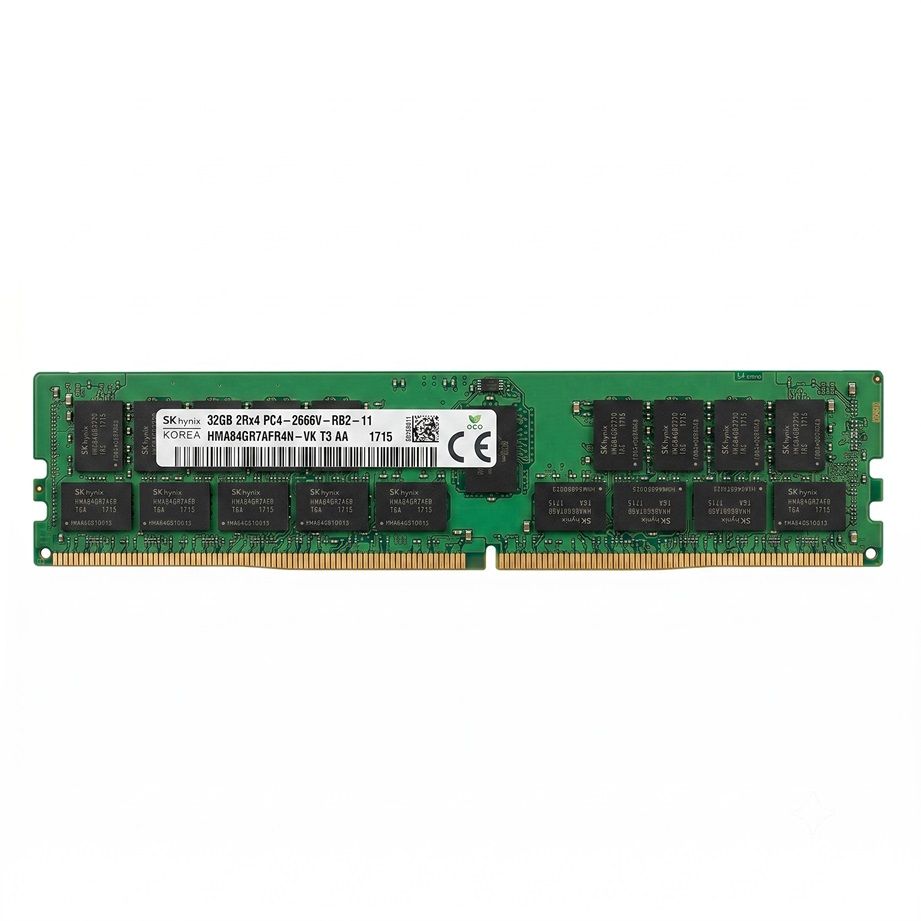
Splitting ddr5 DIMMs into multi-sub-channels optimizes concurrent data flow. This internal parallelism hides raw DRAM latency during parallel operations. You maintain effective server memory architecture by selecting a balanced ddr5 server memory module to preserve overall system stability.
Key Reliability and Power Features in DDR5 RAM
Data center hardware requires continuous operational reliability under intensive compute loads. Modern enterprise applications demand strong protection mechanisms to prevent system crashes and operational downtime. Selecting advanced hardware equips your cloud infrastructure with enterprise-grade stability and sustained thermal control.
On-Die ECC and Side-band Error Correction
|
Technical Dimension |
On-Die ECC |
Side-Band DRAM Bus ECC |
|---|---|---|
|
Coverage Scope |
Internal DRAM chip only |
Entire data path (chip, PCB, memory controller) |
|
Core Purpose |
Boosts chip reliability as cell size shrinks |
Ensures end-to-end data integrity |
|
In-Transit Protection |
None |
Active transmission path protection |
|
Correction Capability |
Single-bit errors (SEC) |
Single-error correction, double-error detection (SEC-DED) |
Next-generation ddr5 technology introduces internal cell protection directly inside the DRAM chip. The chip calculates and stores 8 internal error correction bits for every 128 data bits. This mechanism corrects single-bit errors locally during read operations. However, local schemes ignore transmission path errors.
Enterprise servers combine internal protection with side-band error correction code to secure the entire data path. This full bus protection repairs transmission errors between the memory controller and the module. Together, these combined mechanisms improve hardware reliability and produce 18% fewer memory-related failures in mission-critical environments. You protect overall data integrity across every active compute channel.
On-Module PMIC and Thermal Efficiency
Standard legacy modules depended on motherboard circuits for voltage regulation. Modern ddr5 ram shifts power regulation directly onto the memory module using an onboard Power Management IC. The onboard controller takes a bulk 5V input and steps it down to 1.1V locally.
-
Shorter Power Delivery Paths: Placing regulation on the module shortens electrical trace lengths and lowers trace resistance.
-
Faster Dynamic Response: Localized power control responds quickly to changing processing demands.
-
Tighter Voltage Control: Local regulation reduces electrical noise and prevents voltage loss.
Lowering operating voltage from 1.2V to 1.1V yields a 15% decrease in memory power consumption compared to legacy standards. This reduced energy usage minimizes heat generation in high-density enterprise chassis. Choosing high-density ddr5 ram lowers cooling demands across dense rack environments. This smart energy management optimizes total cost of ownership while maintaining peak system performance. High-density ddr5 ram delivers outstanding reliability and energy efficiency for demanding enterprise servers.
You optimize server memory procurement by balancing workload demands, density targets, and budget limits. Selecting a proper server memory module ensures long-term operational success. You must cross-reference motherboard Qualified Vendor Lists before purchasing ddr5 hardware. Unverified memory choices cause initialization stalls and spontaneous system reboots. Vendor testing validates memory chip stability under heavy compute loads.
Executing a planned server ram upgrade improves overall processing performance. Deploying energy-efficient 1.1V ddr5 components lowers power consumption and thermal output across data center racks. Strategic rank management maximizes bandwidth across active channels. Careful ddr5 planning protects your infrastructure reliability during critical server upgrades. Smart upgrade planning optimizes your total cost of ownership over time.
FAQ
Why should you choose ddr5 ram for your enterprise servers?
Modern servers require fast processing for heavy compute tasks. Deploying ddr5 ram boosts total system bandwidth. Next-generation ddr5 technology increases operational reliability. You lower overall energy consumption through efficient 1.1V operation.
How does a server ram upgrade improve system bandwidth?
Executing a server ram upgrade expands active data channels on your motherboard. A high-performance 64GB ddr5 module transfers data up to 5600 MT/s. This high speed reduces raw memory latency during intense parallel operations. You eliminate severe performance bottlenecks across your data center.
What makes RDIMMs the best ddr5 ram for mission-critical workloads?
RDIMMs buffer address and command signals to reduce electrical load on memory controllers. Selecting the best ddr5 ram ensures robust signal integrity across multi-DIMM channel configurations. This balanced server memory design helps you execute a smooth system upgrade without sacrificing bus frequency.
How do dual-rank modules benefit planned server upgrades?
Dual-rank 2Rx4 modules balance capacity and signal quality across motherboard traces. You maximize per-socket density while maintaining high ddr5 ram throughput across populated channels. Planning strategic server upgrades with ddr5 hardware secures your infrastructure. This hardware upgrade optimizes long-term total cost of ownership.