Magnetic track lighting is widely used in retail, hospitality, and architectural spaces due to its modular flexibility and clean ceiling integration. However, in real-world installations, performance issues often appear after commissioning.
These issues are rarely caused by the lighting modules themselves. Instead, they come from system-level electrical design limitations such as load distribution, voltage drop, driver behavior, and connection constraints.
System Architecture
A 24V magnetic track lighting system is not a simple lighting product. It is a low-voltage distributed power system composed of three core parts: the LED driver, the magnetic track, and the lighting modules.
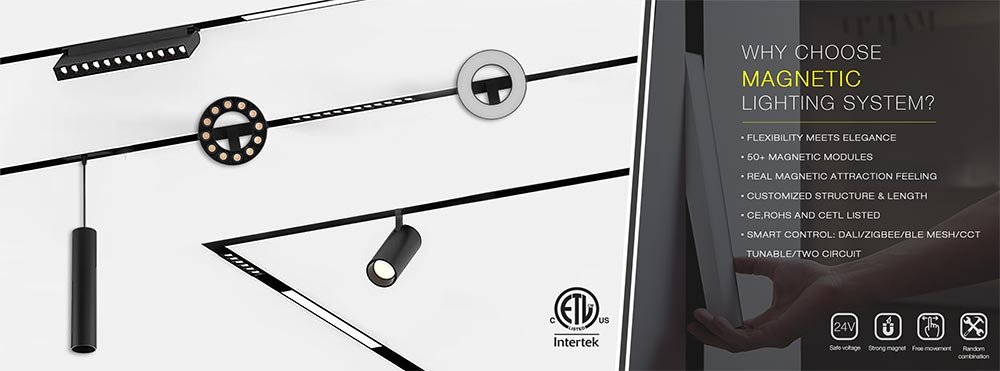
Unlike traditional lighting systems, power is not delivered to a single point load. Instead, it is distributed along the entire track, which makes system behavior dependent on electrical resistance, current flow, and connection quality.
Voltage Drop in Long Track Runs
In long installations, uneven brightness is one of the most common issues. Lights near the power feed appear normal, while those further away gradually become dimmer.
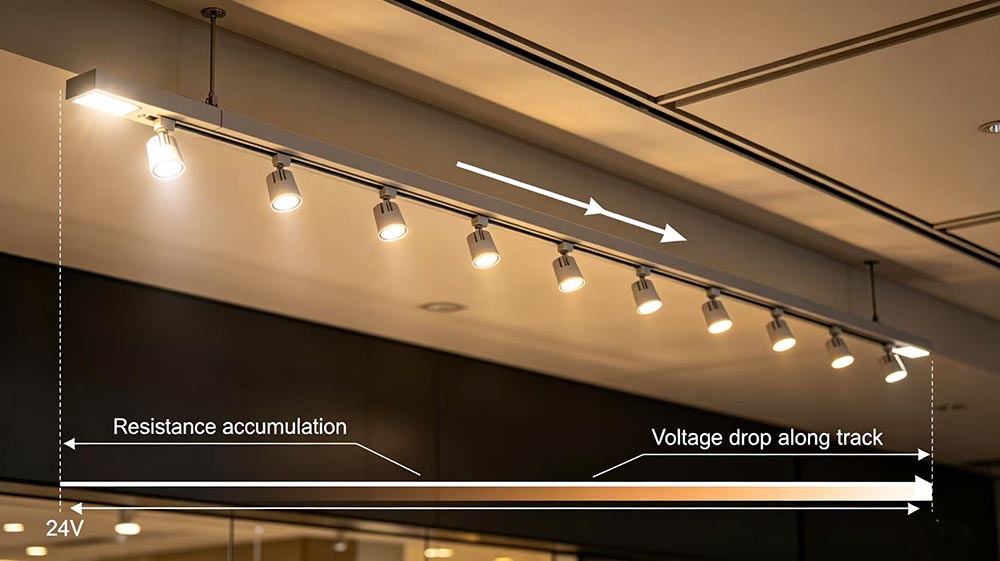
This is caused by voltage loss along the conductive path of the track. As current travels through the system, resistance accumulates, and the available voltage decreases at distant points.
The effect becomes more visible when:
- the track length increases
- the total load approaches system limits
- a single power feed is used for a long continuous run
This is not a fixture defect, but a natural electrical behavior of low-voltage distribution systems.
9A Current Constraint and Power Limit
In our 24V magnetic track system, each line uses a WAGO connector with a rated current of 9A. This translates to approximately 200W of practical safe load per line.
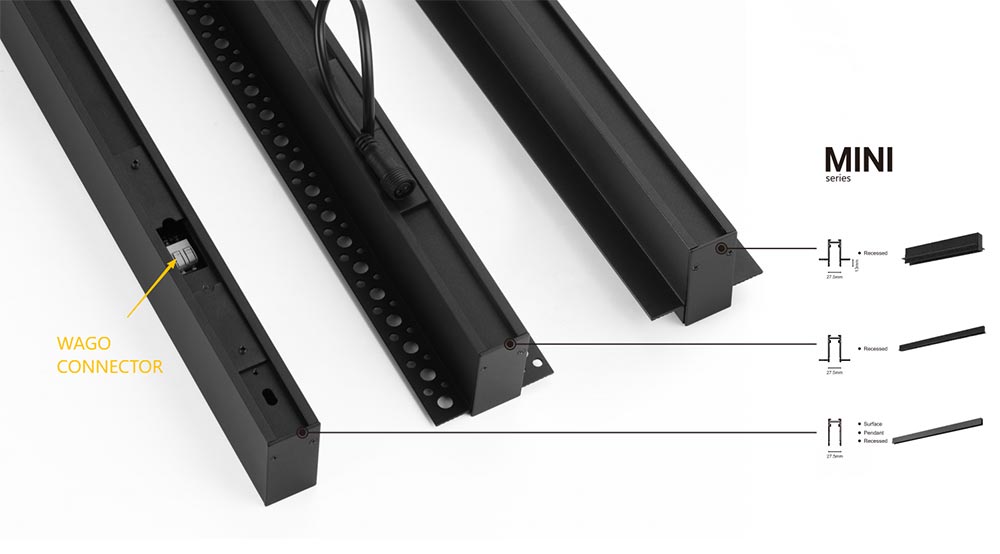
Although the theoretical calculation gives a slightly higher value, real-world conditions are different. Continuous operation introduces heat buildup, and contact resistance at connection points gradually increases over time.
When a system consistently operates beyond this threshold, it does not fail immediately. Instead, it slowly loses stability—first through slight dimming inconsistency, then through flickering under load, and eventually through reduced system lifespan.
This is why the 200W range is treated as a stable engineering boundary rather than a theoretical maximum.
Driver Behavior Under Load
LED drivers in magnetic track systems operate under constant voltage conditions, typically with an efficiency range between 80% and 90%.
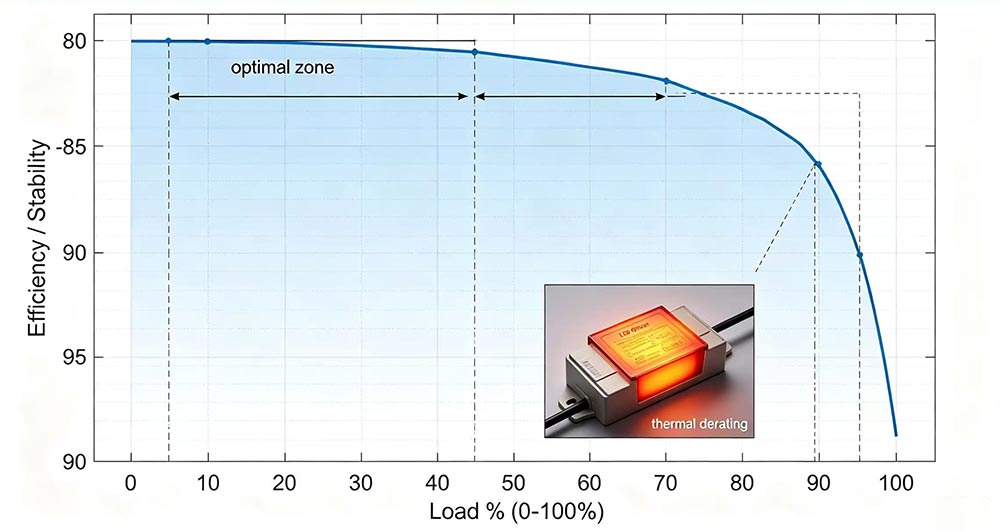
When a driver operates close to its rated capacity, internal temperature increases and output stability gradually decreases. This affects both brightness consistency and dimming performance.
In practical design, stable systems are usually kept within 70%–85% of driver capacity, rather than operating at maximum load.
Flicker and Dimming Instability
Flickering is one of the most frequently misunderstood issues in magnetic track lighting systems. It is often incorrectly attributed to fixture quality, but in most cases, it is caused by system incompatibility.
This includes mismatches between dimming protocols, unstable load conditions, and voltage fluctuations in long track runs.
These issues become more visible when multiple factors overlap, such as long track distance combined with high load or incorrect driver selection.
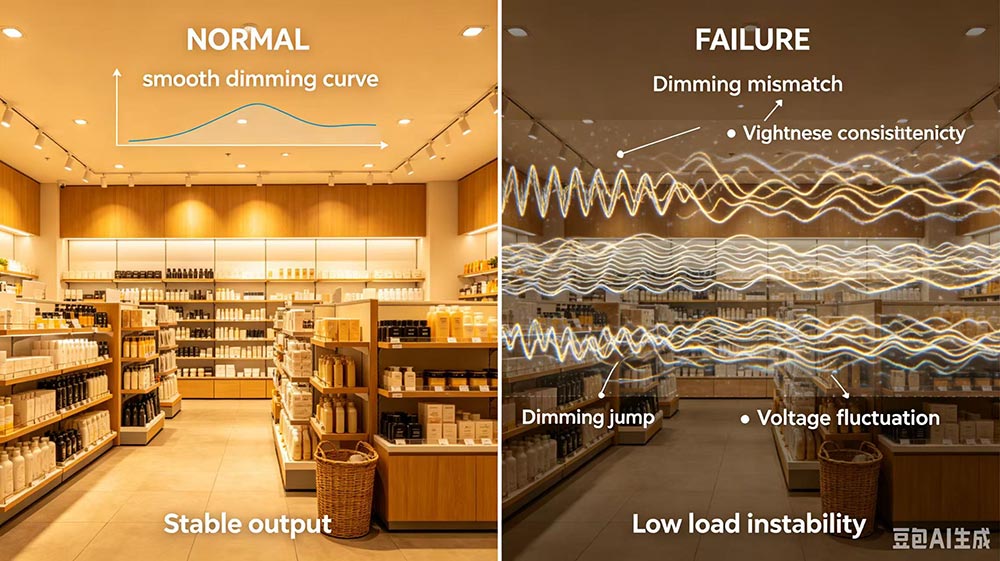
Failure Mechanisms in Real Projects
Most performance issues in magnetic track lighting systems do not originate from a single cause. Instead, they result from the interaction of multiple system-level constraints.
When voltage drop, current limitation, driver loading, and dimming compatibility are not properly coordinated, the system gradually loses stability over time.
Typical manifestations include uneven brightness, flickering under load, or reduced dimming range. These are not sudden failures, but progressive system behavior.
A stable magnetic track lighting system is defined not by individual components, but by system-level coordination.
Key design principles include:
- maintaining load within safe current limits (≈200W per line)
- avoiding excessive driver loading
- controlling voltage drop in long runs
- ensuring proper power distribution design
- matching dimming systems correctly
When these conditions are properly managed, the system delivers stable brightness, reliable dimming, and long-term operational stability in commercial environments.